
BuildingAutonomy
Embedded Intelligence for Building Automation Systems
Analytics that investigate, not just alert
Every building generates thousands of alarms, drifting setpoints and slow-burn inefficiencies. Most analytics tools surface them into yet another dashboard nobody has time to check – and the gap between knowing and doing is where energy is wasted, plant degrades and small faults become expensive failures.
Alarm fatigue
Hundreds of alarms a week, most of them noise. The serious ones drown.
The dispatch gap
Even when a fault is found, someone still has to work out who’s responsible for it, write the email and chase it.
Silent energy sinkholes
Simultaneous heating and cooling, plant running out of hours, valves passing. Invisible on a dashboard summary, expensive on the meter.
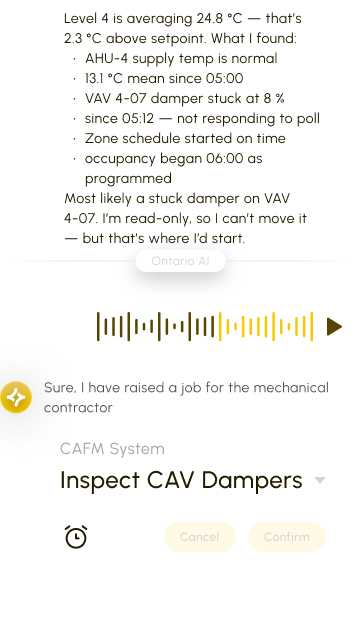
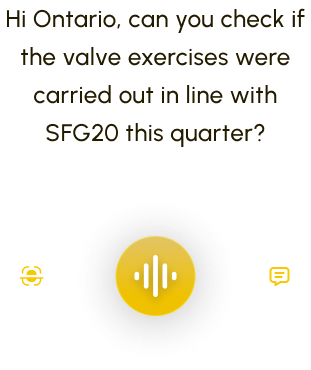
Ontario AI works the problem.
Ontario AI runs inside your BMS. Ask it about a fault, an alarm or an energy concern and it investigates: it queries live points, trend history, alarm records and your O&M manuals, then explains the cause in plain English with the evidence attached. You get an answer that’s already worked out, not just another flag.
From symptom to site visit, in one conversation.
- 01
Ask in plain English.
Talk to Ontario AI through your Niagara supervisor in a web browser, or from your phone via Telegram. Microsoft Teams and email are on the way.
- 02
Ontario diagnoses at the source.
A team of AI agents queries live points, history logs, alarm records and your O&M manuals. It runs natively inside your Niagara supervisor, so your BMS isn’t copied to an outside platform.
- 03
It explains the finding.
Not raw data, but a structured diagnosis: what’s wrong, the evidence for it, and what should happen next.
- 04
Dispatch gets the right team moving.
With your approval, Ontario AI Dispatch routes the issue to the team responsible – your in-house engineers, your FM provider or the contractor who maintains that system – with the diagnostic evidence attached.
Minutes from first symptom to the right team holding a full diagnostic brief. Not days of email tennis.
The building intelligence you’ve been promised.
Before Ontario AI goes live, our engineers survey your BMS and build a verified model of your building: its equipment, spaces, schedules and how they connect, checked against the live station. That model is what turns a chatbot into an analyst. It finds faults faster, separates what matters from noise, and puts your building’s design intent within reach of everyone on your team – not just the person who commissioned it.
Rapid fault finding
Ontario AI knows your equipment, schedules and control relationships, so it can follow a fault back towards its cause in seconds – instead of hours paging through graphics by hand.
Alarms in context
Ask Ontario AI to triage your alarms and it sorts them into serious faults, comms issues and false positives, using what it knows about your building to tell them apart.
Your building’s knowledge, on every desk
The makeup, design intent, and quirks of your building stop living in one engineer’s head. Anyone on your team can ask Ontario AI how a system is meant to work and get the real answer.
An analyst on call for your whole team.
Device health checks
Reports comms statistics, faults and online status for any device on the station, so you can spot failing controllers early.
Fast reactive response
Report a fault at 7am and have a diagnosis, with the evidence attached, in minutes – not after the next engineer visit.
Energy sinkhole detection
Ask about out-of-hours running, plant fighting itself or drift from design intent, and get an answer backed by your trend data.
Alarm triage
Separates serious faults from false positives and comms noise, so your team acts on what matters.
Deep device diagnosis
Inspects control logic, schedules and live comms health for any device on the station.
Design-intent checking
Reads your O&M manuals and compares documented sequences and setpoints with how the building is actually running.
Illustrative examples. Equipment names and figures are for demonstration only.
Inside your BMS, not bolted onto it.
Ontario AI is a native Tridium Niagara 4 module that runs in your supervisor station. It reads your building data at the source, using the same mechanisms as your graphics and reports, and connects out to AI services only when it needs to answer a question.
Read-only by design
Building Analyst observes and analyses. It cannot write to points, change setpoints or alter control logic.
No inbound connections
No open ports and no inbound HTTP. The module makes outbound connections only; nothing on the internet can reach in.
Clear about what leaves the building
To answer a question, Ontario AI sends the relevant data over an encrypted connection to its AI providers, Anthropic and OpenAI. Only what’s needed for that answer is sent, and large result tables go straight to your screen without passing through the AI model. O&M manuals you share with us are indexed so answers can cite them. Ask us for full details of our data handling.
Lightweight on OT networks
Runs where your data lives, so there’s no parallel platform loading your network.
Dispatch: every issue to the team that owns it.
Ontario AI Dispatch knows who is responsible for each part of your building – your own engineers, your FM provider, or the specialist contractors who look after lifts, chillers and controls. When Ontario AI finds a fault, or you report one, Dispatch matches the event to the responsible team and drafts a brief: a clear description of the issue, the affected equipment, and the evidence pulled straight from your BMS. Nothing is sent until someone on your team approves it.
Lift out of service on level 4
Ontario AI confirms the fault from the alarm database and checks it isn’t a comms dropout. Dispatch routes it to your lift maintenance contractor, with the fault code and time of failure.
AHU supply temperature won’t hold setpoint
Ontario AI traces the control loop and finds a valve commanded open with no temperature response. Dispatch routes it to your in-house engineering team, with the trend data showing exactly when the valve stopped responding.
BMS controller offline
Comms diagnostics confirm the device is down, not just quiet. Dispatch routes it to your BMS contractor, with the device health report – before anyone on site has noticed a blank graphic.
What each team receives
- A plain-language description of the fault
- The affected equipment and location
- Supporting evidence: alarm records, trend charts and device health data
- Everything they need to arrive with the right part, not a clipboard
You set who owns what; your team approves every dispatch. Ontario AI investigates and routes – it never changes anything in your BMS.
Stop watching dashboards. Start driving action.
Tell us about your building and we’ll show you what Ontario AI would find in it.
Contact usOr email us directly at hello@buildingautonomy.co.uk